

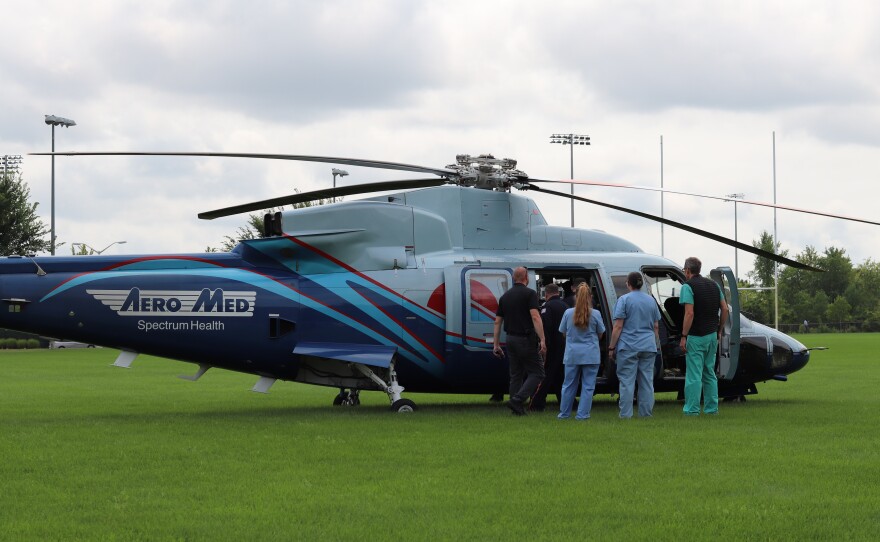
A Corewell Health Aero Med helicopter touched down on Michigan State University’s campus Monday as part of testing for MSU’s new Spartan Canine Shield initiative — a program designed to airlift injured police and military dogs to advanced emergency care.
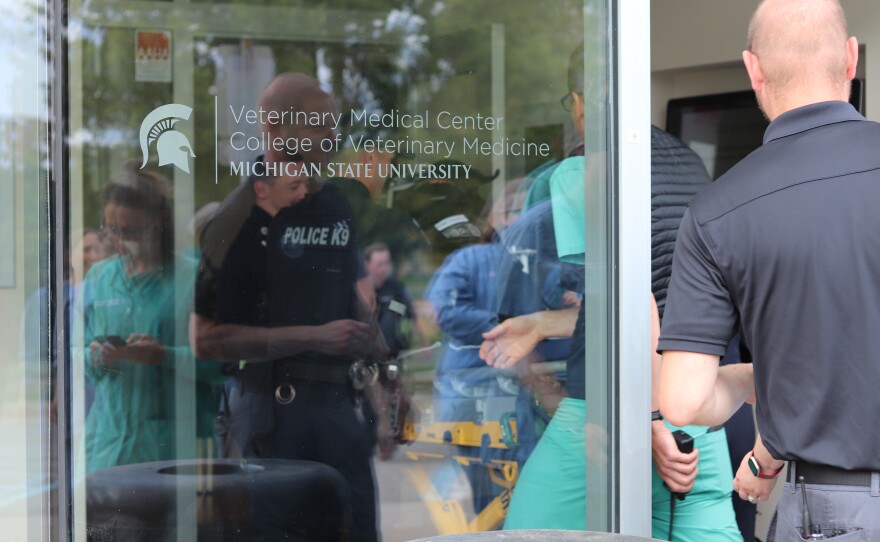
The effort centers on MSU’s Veterinary Medical Center, where emergency services and critical care specialist Matthew Beal says helicopters could soon bring working dogs from across the state directly to MSU for rapid, specialized treatment.

“We're a specialty hospital, my team is emergency and critical care medicine,” Beal said. “But we have an on‑call surgery team, on‑call anesthesia team, on‑call blood bank, [and an] on‑call imaging team.”
To support the program, MSU has built a hospital‑wide response system that mobilizes critical care teams before a canine patient arrives. Beal says that speed is crucial when dogs suffer severe trauma or other life‑threatening emergencies.

“MSU IT and Communications built a system for us,” he said. “At the push of a button, a robocall goes out that says, ‘Hey, we've got an operational K‑9 injured. He’ll be here in X minutes,’ and everyone converges on this place.”
When a police or military K‑9 is hurt, the dog’s handler contacts Aero Med. The dispatch center then alerts MSU’s Veterinary Medical Center and coordinates with local emergency responders to get the dog to campus as quickly as possible.
“It’s exciting, but we’re really hoping that we never have to push that button,” Beal said. “It means that a dog like Shadow over there has been critically ill or injured.”
Shadow — a calm, black Labrador who serves as one of the hospital’s blood donors — acted as a “patient” for Monday’s test, riding in on a stretcher while MSU’s care team practiced the protocol for a true emergency.
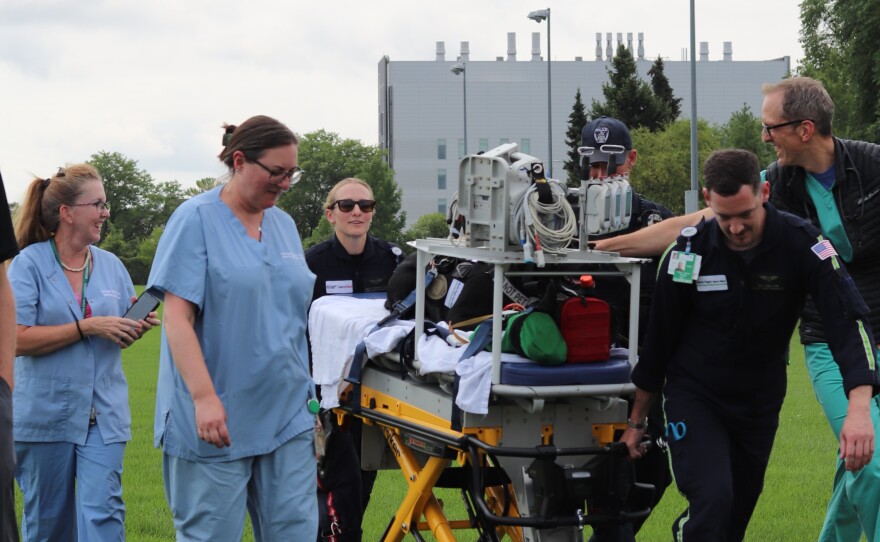
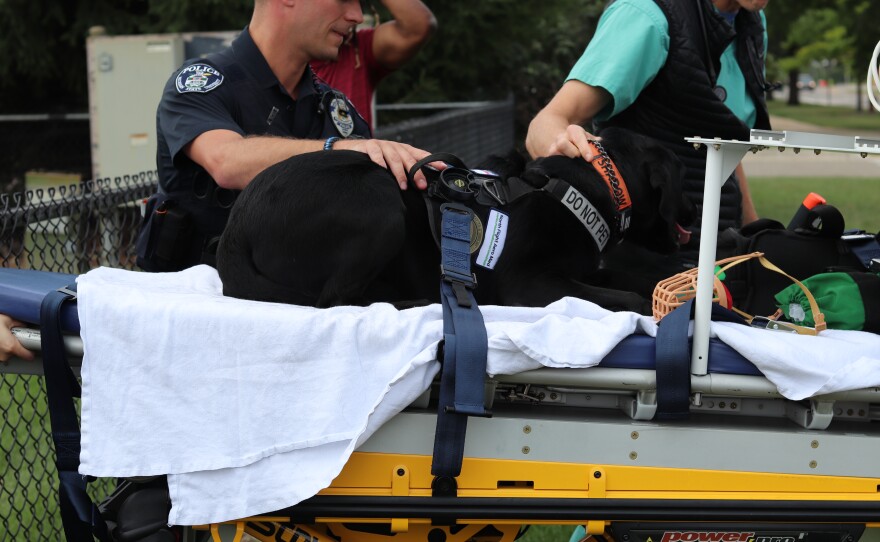

“Shadow’s a superstar” Beal said. “Every six to eight weeks, he gives blood that helps another dog here at the hospital. He’s the perfect dog to transport because he’s easygoing, a little less on the tactical side of working dogs.”
The Spartan Canine Shield program remains in its testing phase, with more details expected this fall.