Traveling south from Lansing on M-99, I found myself crossing a bridge over the Grand River and rolling onto a bustling island.
Eaton Rapids has two titles that it carries like a badge of honor. The first, Michigan’s Island City, as its downtown thoroughfare is built on a chunk of land surrounded on all sides by the Grand River.
The other title is simply “The World’s Only.”
Eaton Rapids, the small mid-Michigan city with a population of just over 5,000 people, is the only city by that name.
The city is unique in other ways, too.
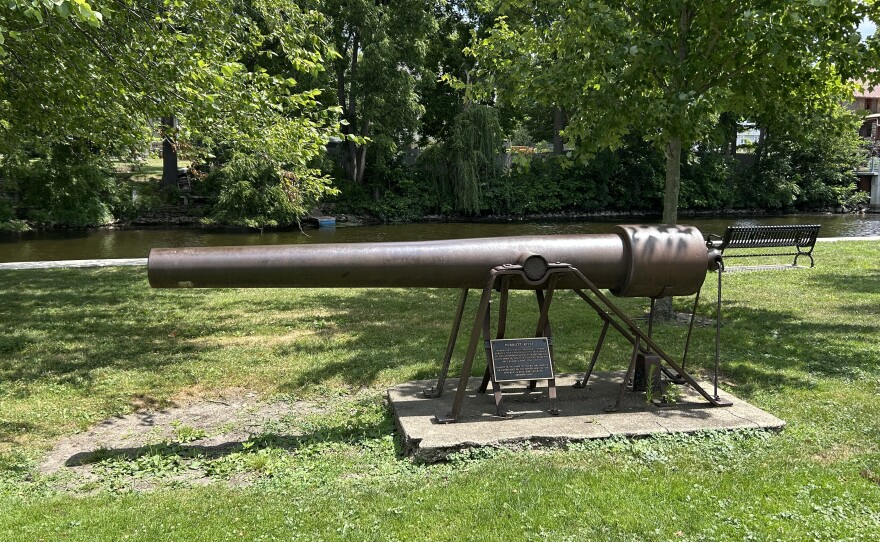
One of the city parks serves as the home of what is thought to be the last remaining Parrott Rifle, an experimental cannon made for the Union Army in 1864.
Even the phone booth on the corner of East Hamlin and Main Streets bears a sign calling it “possibly the only phone booth.”
What I found to be most unique about Eaton Rapids after spending an afternoon lost downtown, though, was the city’s charm.
Local businesses, old and new
One of the best ways to familiarize yourself with a small town is to go into the local businesses. For Eaton Rapids, that meant visiting Pettit Hardware.

Pettit Hardware has been operating for 140 years, making it the oldest local business in Eaton Rapids. It beat out Abie’s Bar for the title by just one year.
Pettit Hardware was built inside the former home of Kositchek’s, a men’s clothing store that relocated to Lansing in the late 1800s.
The building maintains the original wood flooring and ornate ceiling tiles from its 1866 construction.
“Civil War soldiers have walked on this floor,” store clerk Wayne Jackson said. “That’s a long time ago.”
Jackson has worked at Pettit Hardware for 20 years, and he said he appreciates that the store keeps him in touch with the local community.
“You can go into any store, and you can run into somebody that maybe you've gone to school with,” he said. “You get to know everybody.”
Jackson and his coworker, Bruce, told me about some of the Eaton Rapids residents they’ve gotten to know while working at Pettit Hardware.
“We even taught a lady how to solder one time,” Jackson said. "She couldn't afford to hire a plumber, and she needed some help. And we just showed her how to. It's not going to look pretty, but it'll be functional, and she could do it. She did it. That's what you're never going to get in the big stores.”
After spending some time at the oldest business in town, it only felt fair to visit the youngest.

The Gold Thimble, a quilting shop just down the street from Pettit Hardware, has only been open for four months.
It was opened by Eaton Rapids-local Wendy Stahl. Her sister, Amanda McLendon, said the store was Stahl’s dream.
“My mom works here. My daughter's here, and granddaughter's here sometimes,” McLendon said. “This was her dream, so we just make it happen for her.”
McLendon’s family has a long history of quilting, with some of her great-grandmother's quilts displayed on the walls of the shop.
“My mom started, then she had my sister go to a quilt retreat with her, and my sister got hooked,” she said. “We started having Mom and Me weekends is what we called it, and my brother came, and he's made quilts, and my granddaughter, who is now 19 months old, has been behind a sewing machine since four months old. That was her first Mom and Me weekend.”
The Gold Thimble is not the first quilt shop to grace the streets of Eaton Rapids. The sewing machine and quilt shop Country Stitches first opened on Main Street in 1982, before later relocating to East Lansing.
“People are loving having a quilt store in their town again,” McLendon said.

While quilting is the family’s shared passion, the family does embrace other fiber arts, too. McLendon’s own textile art, which is a fabric collage recreation of an image of her father, hangs proudly behind the counter of the store.
“There’s so much you can do with fabric,” she said.
Walking talking history
Just outside the Eaton Rapids Area District Library, I ran into former Mayor of Eaton Rapids Paul Malewski.
Malewski has been a resident of Eaton Rapids since 1981, and he served as the mayor from 2018 through 2021.
“I was out there every day, and I still am,” he said. “People really embraced that. You got to be out there every day because the important thing about living here and working here is that people are not blank slates.”
Prior to his time as mayor, Malewski was Eaton Rapids’ chief of police. Nowadays, he’s a kayaking instructor with Team River Runner, which teaches veterans and people with disabilities how to kayak.
Kayaking around Eaton Rapids, he said, is his personal heaven.
“When you paddle here on the weekends, it’s so much fun. There’s so many people out there. Everybody’s having a good time. You’re going down the river. You’re talking. You’re chatting. You’re enjoying yourself,” Malewski said. “Any given Sunday, I probably run into 200 people.”
He said he takes to the water from Mill Pointe Park, where the rapids are strongest.

Malewski said that, while Eaton Rapids doesn’t have the most diverse community, it’s not that the city wouldn’t be welcoming.
“I think that, on the other side of the coin, there's some trepidation on some folks’ part that, well, ‘I'm of a different race, or I have adopted a different lifestyle, and a small town is going to reject me and not want me here,’” he said. “That's not true here. That’s absolutely not true here.”
"Eaton Rapids is the heart of mid-Michigan,” Malewski added.

Living in the present, looking to the future
Each resident of Eaton Rapids that I spoke with shared the same hope for the future of the city: For the city to grow but not lose its small-town charm and hospitality.
“People here will give you the shirt off their backs all day long, and they’ll smile when they do it,” Malewski said. “And that’s just so important, you know? It’s the hometown feel.”
The willingness to go the extra mile to help out a neighbor extends to the local businesses, too.
“The kind of service you would get here, you're not going to get somewhere else,” Jackson said. “And when stores like this are gone, it's gone for good.”
And while everyone shared the wish for Eaton Rapids to grow, no one wants to see the city lose its unique identity.
“Too many small towns become the large towns, and they lose their charm,” McLendon said. “They lose their friendliness, and I'd like to see it keep that, but still be prosperous.”