

EAST LANSING, MICH.- Michigan State is widely recognized for having one of the top turfgrass research programs in the country. But the pristine varsity athletic fields that fans see on game day aren’t maintained by researchers, they’re cared for by a dedicated athletic turf team working behind the scenes year-round to keep every playing surface in top shape.
For Andy Flynn and his staff, that responsibility means preparing fields to be game-ready…no matter the conditions. And in Michigan, where the weather can swing dramatically from one day to the next, maintaining healthy turfgrass is often a battle against the climate itself.
“Weather dictates pretty much everything we’re doing. It creates a huge challenge for us because our growing season is a little bit shorter. The majority of varsity playing seasons are taking place when the grass isn’t even growing,” said Flynn, MSU’s head athletic turf manager.
Because the majority of Michigan State sports are played during months when weather conditions make it difficult for turfgrass to grow consistently, Flynn and his team face a unique challenge. One of their biggest priorities is finding ways to grow and maintain as much healthy turfgrass as possible in the summer.
“We have to make sure we're doing everything that we need to do to make the plants as healthy as possible to get us into the fall season, because once we hit the middle of October, things are shutting down in terms of growth,” said Flynn.
Each sport and athletic field presents its own issues. The football field at Spartan Stadium undergoes significant wear and tear due to games and the length of the season. The main goal is to focus on three areas in preparing the field for optimal performance and playability.
“Safety is first and foremost, allowing the surface to give our student-athletes the ability to perform the way they want to. Then it’s the playability of the field. And lastly, the overall appearance; we want the field to look as green as it can be, as white as possible in terms of paint,” said Brian McDougal, the head groundskeeper for Spartan Stadium.
In 2019, Spartan Stadium installed a new playing surface, replacing the old module field system from 2002. One of the main factors that determines a field’s lifespan is controlling the amount of plant breakdown in the sand-based root zone of the field.

Flynn explained more on the importance of maintaining the football field's sand-based root zone. “Every time they play, I end up vacuuming about 100 pounds of dead grass. The players chew up the turf, and as the leaf tissue, roots, and stems break down, they become fine organic particles that work into the sand and compromise the sand-based system,” said Flynn.
Vacuuming the field is one of the main post-game cleanup tasks that Flynn and McDougal perform. In addition to vacuuming, there are many repairs required for the turfgrass.
“In season, after every game, we vacuum the field with the lawn mower. Then the following morning, me, Andy, and our turf program students perform at least two full days of repairs. We'reconstantly seeding and trying to get the grass to grow as long and late into the season as we can,” said McDougal.
But after the season is done and warmer weather becomes more consistent, one of the main priorities in the summer is focusing on the aerification of the football field.
“We put about 100 tons of sand out on the field from April all the way to our very last football game, which helps with drainage, surface smoothness, and overall stability, and we start our cultural practices as soon as we can, regrowing the football field in time before spring football,” said McDougal.

One of the main features that sets Michigan State’s athletic fields apart from other universities is the commitment to natural grass. Not only does Spartan Stadium use a natural playing surface, but so do the fields at Old College Field, home to men’s and women’s soccer, as well as baseball and softball.
Flynn explained that this choice is increasingly rare in college athletics. “We're one of the few colleges that still have natural grass athletic fields everywhere. The reason why a lot of places go to artificial turf is because it’s not easy to maintain, especially in the north,” said Flynn.

What many people don’t know is the difficulty of maintaining the athletic fields at Old College Field due to its location and conditions.“That facility sits on a floodplain. It floods at least once a year and sometimes more than once, and it's a very challenging scenario to have Division I varsity athletic fields in a floodplain. It goes back to a saying we have: ‘Any grass is good grass,’” said Flynn.
Despite those setbacks, Flynn says the work never slows — and neither does the commitment his staff brings to it.
“We put in a lot of ridiculous hours, and you gotta have the right mentality for it — and they all do, it’s the main reason we're successful,” said Flynn.
For most fans, the field is just the backdrop. For Flynn and his crew, it’s the result of countless unseen hours, early mornings, and a shared dedication to giving every athlete the best surface possible. And as long as the seasons keep changing, they’ll be out there — preparing the next field, ready for the next challenge.

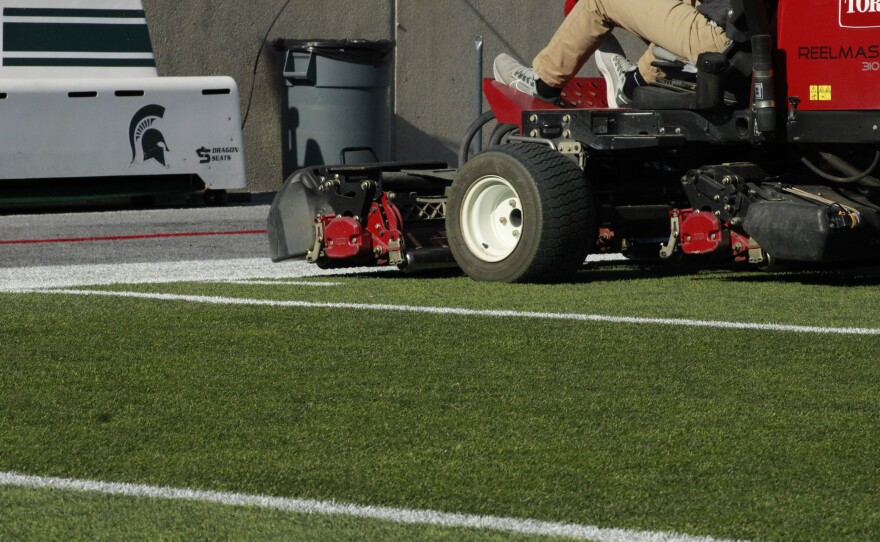
- McDougal Striping the field before Michigan State’s Football game against Penn State on Nov. 14, 2025.
- NCAA Women's Soccer Tournament Banner at the Old College Field Gates on Nov. 14, 2025.
- The soccer field at DeMartin Stadium on Nov. 14, 2025, the day before the first round of the NCAA Women’s Soccer Tournament.
- Michigan State athletic turf workers performing final checks on the field at DeMartin Stadium ahead of the first round of the NCAA Women’s Soccer Tournament, Nov. 14, 2025
- Michigan State Athletic Turf workers inspecting the field ahead of the first round of the NCAA Women’s Soccer Tournament, Nov. 14, 2025
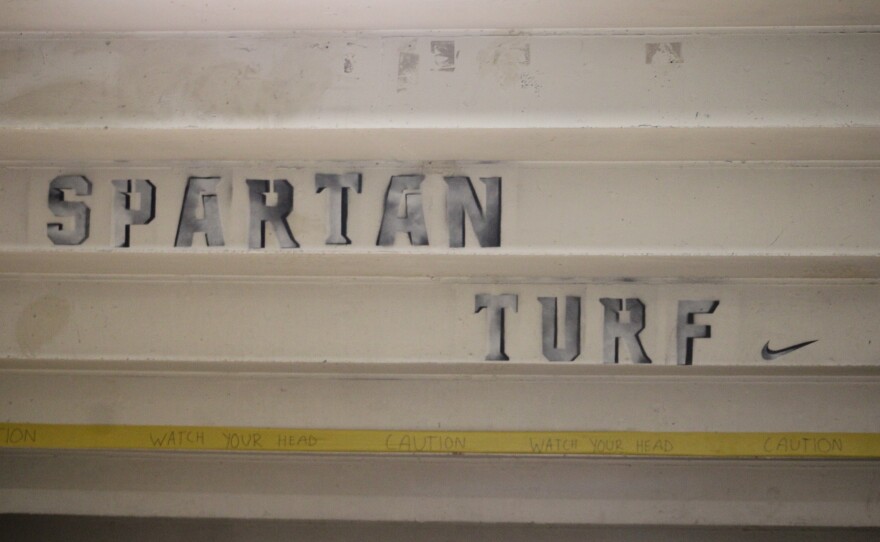
- Spartan Turf logo displayed under the bleachers at Spartan Stadium, Nov. 14, 2025
- McDougal Striping the field before Michigan State’s Football game against Penn State on Nov. 14, 2025.
- NCAA Women's Soccer Tournament Banner at the Old College Field Gates on Nov. 14, 2025.
- The soccer field at DeMartin Stadium on Nov. 14, 2025, the day before the first round of the NCAA Women’s Soccer Tournament.
- Michigan State athletic turf workers performing final checks on the field at DeMartin Stadium ahead of the first round of the NCAA Women’s Soccer Tournament, Nov. 14, 2025
- Michigan State Athletic Turf workers inspecting the field ahead of the first round of the NCAA Women’s Soccer Tournament, Nov. 14, 2025
- Spartan Turf logo displayed under the bleachers at Spartan Stadium, Nov. 14, 2025
- McDougal Striping the field before Michigan State’s Football game against Penn State on Nov. 14, 2025.
- NCAA Women's Soccer Tournament Banner at the Old College Field Gates on Nov. 14, 2025.
- The soccer field at DeMartin Stadium on Nov. 14, 2025, the day before the first round of the NCAA Women’s Soccer Tournament.
- Michigan State athletic turf workers performing final checks on the field at DeMartin Stadium ahead of the first round of the NCAA Women’s Soccer Tournament, Nov. 14, 2025
- Michigan State Athletic Turf workers inspecting the field ahead of the first round of the NCAA Women’s Soccer Tournament, Nov. 14, 2025
- Spartan Turf logo displayed under the bleachers at Spartan Stadium, Nov. 14, 2025

- McDougal Striping the field before Michigan State’s Football game against Penn State on Nov. 14, 2025.
- NCAA Women's Soccer Tournament Banner at the Old College Field Gates on Nov. 14, 2025.
- The soccer field at DeMartin Stadium on Nov. 14, 2025, the day before the first round of the NCAA Women’s Soccer Tournament.
- Michigan State athletic turf workers performing final checks on the field at DeMartin Stadium ahead of the first round of the NCAA Women’s Soccer Tournament, Nov. 14, 2025
- Michigan State Athletic Turf workers inspecting the field ahead of the first round of the NCAA Women’s Soccer Tournament, Nov. 14, 2025
- Spartan Turf logo displayed under the bleachers at Spartan Stadium, Nov. 14, 2025

- McDougal Striping the field before Michigan State’s Football game against Penn State on Nov. 14, 2025.
- NCAA Women's Soccer Tournament Banner at the Old College Field Gates on Nov. 14, 2025.
- The soccer field at DeMartin Stadium on Nov. 14, 2025, the day before the first round of the NCAA Women’s Soccer Tournament.
- Michigan State athletic turf workers performing final checks on the field at DeMartin Stadium ahead of the first round of the NCAA Women’s Soccer Tournament, Nov. 14, 2025
- Michigan State Athletic Turf workers inspecting the field ahead of the first round of the NCAA Women’s Soccer Tournament, Nov. 14, 2025
- Spartan Turf logo displayed under the bleachers at Spartan Stadium, Nov. 14, 2025
- McDougal Striping the field before Michigan State’s Football game against Penn State on Nov. 14, 2025.
- NCAA Women's Soccer Tournament Banner at the Old College Field Gates on Nov. 14, 2025.
- The soccer field at DeMartin Stadium on Nov. 14, 2025, the day before the first round of the NCAA Women’s Soccer Tournament.
- Michigan State athletic turf workers performing final checks on the field at DeMartin Stadium ahead of the first round of the NCAA Women’s Soccer Tournament, Nov. 14, 2025
- Michigan State Athletic Turf workers inspecting the field ahead of the first round of the NCAA Women’s Soccer Tournament, Nov. 14, 2025
- Spartan Turf logo displayed under the bleachers at Spartan Stadium, Nov. 14, 2025

- McDougal Striping the field before Michigan State’s Football game against Penn State on Nov. 14, 2025.
- NCAA Women's Soccer Tournament Banner at the Old College Field Gates on Nov. 14, 2025.
- The soccer field at DeMartin Stadium on Nov. 14, 2025, the day before the first round of the NCAA Women’s Soccer Tournament.
- Michigan State athletic turf workers performing final checks on the field at DeMartin Stadium ahead of the first round of the NCAA Women’s Soccer Tournament, Nov. 14, 2025
- Michigan State Athletic Turf workers inspecting the field ahead of the first round of the NCAA Women’s Soccer Tournament, Nov. 14, 2025
- Spartan Turf logo displayed under the bleachers at Spartan Stadium, Nov. 14, 2025